SEO and Digital Marketing: Your Essential Guide to Online Success
In today’s crowded digital marketplace, simply having a website isn’t enough. To truly connect with your audience and grow your business, you need a strategy that puts you in front of them at the exact moment they’re looking for a solution. This is where the powerful partnership of SEO and digital marketing comes into play. While often discussed separately, they are two sides of the same coin, working together to build a formidable online presence. This guide is designed to demystify their relationship, showing you how to weave search optimization into the fabric of your marketing efforts. By understanding this synergy, you’ll unlock the secrets to driving sustainable traffic, building brand authority, and achieving a remarkable return on your investment—principles widely taught by leading digital marketing institutes like Aviv Digital Academy.
Understanding the Fundamentals: What is Digital Marketing and SEO?
To master the synergy between these two disciplines, it’s crucial to first understand them individually. Think of digital marketing and SEO as a team: one is the head coach designing the overall game plan, and the other is the star player executing the most critical plays on the field. Without a solid game plan, the player’s talent is wasted. Without a star player, the plan can’t be executed effectively.
Digital marketing is the broad, overarching strategy. It’s an umbrella term for every marketing effort that leverages an electronic device or the internet. The goal is simple: connect with customers where they spend their time—online. This vast field includes a variety of digital channels and tactics, such as:
Content Marketing: Creating and distributing valuable content like blog posts, videos, and ebooks.
Social Media Marketing: Engaging with audience on platforms like Instagram, LinkedIn, and Facebook etc.
Email Marketing: Nurturing leads and communicating directly with customers.
Paid Advertising (PPC): Paying for ad placements on search engines and social media.
Search Engine Optimization (SEO): Improving your visibility in organic search results.
Notice that last point? SEO isn’t separate from digital marketing; it’s a fundamental component of it. So, what is search engine optimization explained simply?
SEO is the specific practice of optimizing your website and its content to rank higher on search engine results pages (SERPs) like Google—a foundational concept emphasized in practical digital marketing programs such as those offered by Geegs for Geegs.
. The objective is to increase the quantity and quality of traffic to your website through organic search results—meaning traffic you don’t pay for directly. SEO is typically broken down into three core pillars:
On-Page SEO: Optimizing individual web pages with relevant keywords, quality content, and user-friendly structure.
Off-Page SEO: Building authority and trust through activities outside your own site, primarily by earning backlinks from other reputable websites.
Technical SEO: Ensuring a search engine can crawl and index your site without any issues. This involves site speed, mobile-friendliness, and site architecture.
In essence, digital marketing builds the brand and casts a wide net, while SEO ensures that when someone is actively searching for what you offer, they find you first.
Why SEO is the Backbone of Effective Digital Marketing
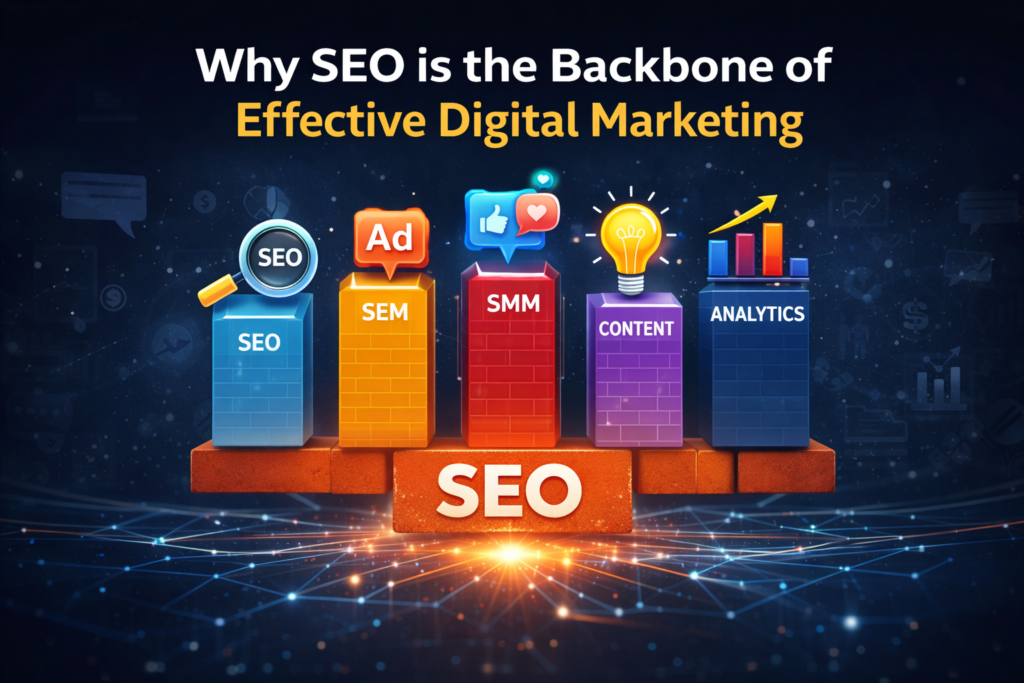
While every digital marketing channel has its place, using SEO for digital marketing is non-negotiable for long-term success. It’s the foundational layer that supports and enhances all your other efforts, acting as the engine for sustainable growth. Unlike paid campaigns that stop the moment you stop paying, a well-executed SEO strategy builds momentum over time, delivering compounding returns.
One of the most significant organic traffic benefits is its sustainability. When you rank high for your target keywords, you receive a consistent stream of relevant visitors, 24/7, without paying for every click. This creates a durable asset. Think of it like owning your online real estate versus renting it. Paid ads are like renting—the traffic stops when the rent is due. SEO is like buying the property; after the initial investment, you own a source of continuous value. This makes it a cornerstone of any effective long-term marketing strategy.
Furthermore, SEO is unparalleled for building credibility and brand authority. A top ranking on Google is a powerful third-party endorsement. It signals to users that your content is relevant, authoritative, and trustworthy. This psychological advantage means users arriving from organic search are often more engaged and more likely to convert. This trust is the bedrock of a strong customer relationship.
Modern SEO is also deeply intertwined with user experience (UX). Google’s algorithms are designed to reward websites that provide a seamless, positive experience. Best practices for search optimization marketing—such as fast page load speeds, mobile-friendliness, intuitive navigation, and high-quality content—are all things that make your website better for human visitors. By focusing on SEO, you are inherently improving your site’s UX, which leads to lower bounce rates, longer session durations, and ultimately, more conversions.
Finally, SEO is an incredibly cost-effective marketing channel. While it requires an upfront investment of time and resources, the ROI can be substantial. The traffic generated is highly targeted (since users are actively searching for your solutions), and once rankings are established, the cost per acquisition drops significantly. This makes marketing SEO one of the most efficient ways to grow your business online.
Integrating SEO for a Powerful Digital Marketing Strategy
The true power of SEO & marketing is unleashed when it’s not treated as a silo but integrated across all your digital channels. Each component of your marketing mix can feed your SEO efforts, and in turn, a strong SEO foundation can amplify the performance of every other channel. This holistic approach creates a self-reinforcing cycle of growth and visibility.
The most natural partnership is between content marketing and SEO. They are inextricably linked. SEO provides the data-driven direction for your content. Keyword research tells you what topics your audience cares about and what questions they’re asking. In return, high-quality, valuable content is the fuel for SEO. It’s what earns backlinks, satisfies user intent, and convinces Google that your site deserves to rank. A blog post optimized for a specific query, a comprehensive guide that becomes a go-to resource, or an engaging video that answers a common question are all examples of this synergy in action.
The role of social media and SEO integration is often misunderstood. While social signals (likes, shares) don’t directly impact your search rankings, social media is a powerful discovery and distribution engine. Sharing your SEO-optimized content on social platforms drives immediate traffic and puts it in front of a wider audience. This increased visibility can lead to more people discovering and linking to your content, which does directly boost your off-page SEO. It’s about using social media to amplify the reach of your SEO assets.
Pairing paid search optimization (PPC) and SEO offers a one-two punch for SERP dominance. Running PPC campaigns can provide invaluable, near-instant data. You can quickly test which keywords have the highest conversion rates and which ad copy resonates most with your audience. This intelligence can then be used to prioritize your long-term SEO efforts. Furthermore, appearing in both the paid and organic sections for a high-value keyword dramatically increases your visibility and click-through rate, reinforcing your brand’s authority and capturing users at different stages of their journey.
Even email marketing has a role to play. You can use your email list to distribute your latest SEO-optimized blog posts, driving traffic back to your site and signaling to Google that your content is engaging. It’s also an excellent channel for nurturing the leads you’ve acquired through organic search, guiding them through the sales funnel and turning a curious searcher into a loyal customer.
Essential SEO Strategies for Boosting Your Digital Marketing Performance
To turn theory into results, you need to implement concrete strategies. Improving your seo performance marketing hinges on a methodical approach that covers everything from research to analytics. Here are the essential pillars you need to focus on to boost your digital marketing efforts.
It all starts with comprehensive keyword research. This isn’t just about finding high-volume terms; it’s about understanding user intent. Are searchers looking for information (informational intent), trying to find a specific website (navigational intent), or ready to make a purchase (transactional intent)? A good strategy targets a mix of broad, short-tail keywords and specific, long-tail keywords that capture users at every stage. Tools like Ahrefs, SEMrush, and even Google’s free Keyword Planner are indispensable for analyzing search volume, keyword difficulty, and what your competitors are ranking for.
Once you have your keywords, the next step is on-page optimization best practices. This is where you make your content perfectly clear to both users and search engines. Your checklist should include:
Title Tags & Meta Descriptions: Craft compelling, keyword-rich titles and descriptions that entice users to click from the SERP.
Headings (H1-H6): Structure your content logically with a single H1 and subsequent H2s and H3s to improve readability and signal topic hierarchy.
Content: Write in-depth, high-quality content that naturally incorporates your target keywords and provides real value to the reader. Use internal links to guide users to other relevant pages on your site.
Image Optimization: Use descriptive alt text for all images and compress them to ensure fast loading times.
Behind the scenes, technical SEO fundamentals ensure your site is accessible and efficient. This includes optimizing for site speed (a key factor in Google’s Core Web Vitals), ensuring your site is mobile-friendly, and securing it with HTTPS. You should also create an XML sitemap to help search engines discover all your pages and use a robots.txt file to control which parts of your site they can crawl. Implementing structured data (schema markup) can also help you earn rich snippets in search results, like star ratings or FAQ dropdowns, making your listings stand out.
No SEO strategy is complete without building high-quality backlinks. Think of backlinks from other websites as votes of confidence that boost your site’s authority. Focus on quality over quantity. Effective link building strategies include creating exceptional content that people naturally want to link to (link-bait), guest posting on reputable blogs in your industry.
Finally, monitoring and analytics are critical. SEO is an ongoing process, not a one-time task. Use tools like Google Analytics and Google Search Console to track your organic traffic, keyword rankings, click-through rates, and user behavior. Analyzing this data will reveal what’s working and what’s not, allowing you to continuously refine your strategy for peak performance.
Navigating SEO Challenges and Future Trends in Digital Marketing

Thinking about SEO in digital marketing means accepting that it’s a dynamic and ever-evolving field. What works today might be less effective tomorrow. Staying ahead requires adaptability and a forward-looking perspective. One of the biggest challenges is Google’s frequent algorithm updates. These can happen multiple times a year and can significantly shift rankings. The key is not to chase algorithms but to focus on a user-centric strategy built on quality content and a great user experience, which aligns with Google’s long-term goals.
Another challenge is the intense competition. In most industries, you’re not just competing with a few local businesses but with global players. Standing out requires a sophisticated strategy, consistent effort, and a deep understanding of your specific niche. This is where focusing on E-E-A-T (Experience, Expertise, Authoritativeness, and Trustworthiness) becomes crucial. Google increasingly prioritizes content that demonstrates real-world expertise and is created by credible sources.
Looking to the future, several emerging trends are reshaping the seo digital landscape:
AI and Machine Learning: Artificial intelligence is now at the core of search algorithms like Google’s RankBrain and is being used to deliver more relevant results. AI-powered tools are also becoming essential for content creation, keyword clustering, and predictive analytics. The rise of Google’s Search Generative Experience (SGE) means optimizing for conversational, AI-driven answers is the next frontier.
Voice Search Optimization: With the proliferation of smart speakers and voice assistants, more searches are being conducted via voice. This requires optimizing for longer, more conversational queries and aiming for featured snippet positions, as these are often read aloud as the answer.
Core Web Vitals and User Experience: The Core Web Vitals impact on rankings is now official. Metrics related to loading speed (LCP), interactivity (FID/INP), and visual stability (CLS) are direct ranking factors. A seamless user experience is no longer just a good idea—it’s a requirement for top performance.
To navigate these changes, you must be diligent about measuring SEO success. Track key performance indicators (KPIs) like organic traffic growth, keyword ranking improvements, conversion rates from organic visitors, and engagement metrics like bounce rate and time on page. By setting realistic goals and continuously analyzing your data, you can adapt your strategy, overcome challenges, and capitalize on future trends to ensure your digital marketing efforts remain successful for years to come.
Conclusion: Your Path to Integrated Online Success
The relationship between SEO and digital marketing is not just a connection; it’s a fundamental dependency. SEO is the powerful, enduring engine that drives the entire digital marketing vehicle. While social media creates buzz and paid ads deliver instant traffic, SEO builds the sustainable foundation of trust, authority, and visibility that yields benefits long after a campaign ends. It ensures that when your ideal customer is actively searching for a solution, your brand is the one they find, trust, and choose.
By integrating SEO into every facet of your strategy—from the content you create and the social media posts you share to the data you gather from PPC—you create a powerful, self-reinforcing ecosystem. Each channel strengthens the others, leading to a whole that is far greater than the sum of its parts. Understanding this synergy moves you from simply participating in online marketing to strategically dominating your digital space.
Don’t view seo of digital marketing as a separate checklist item. Instead, see it as the strategic mindset that should guide all your online actions. Start by conducting thorough keyword research to understand your audience, create valuable content that answers their questions, and ensure your website provides a flawless technical and user experience. The path to lasting online success is paved with a deep, integrated approach to search optimization. Begin implementing these strategies today, and build a digital presence that not only attracts visitors but turns them into loyal customers.
Frequently Asked Questions (FAQs)
Q: What is the main difference between SEO and digital marketing?
A: The main difference is scope. Digital marketing is the all-encompassing term for all online marketing efforts (including email, social media, paid ads, etc.). SEO (Search Engine Optimization) is a specific component within digital marketing focused on improving a website’s visibility in organic (non-paid) search engine results to attract free, relevant traffic.
Q: Can I do digital marketing without SEO?
A: You can, but it’s highly inefficient. Without SEO, you’re missing out on the largest and most consistent source of high-intent traffic. Your website won’t be visible when potential customers are actively searching for your products or services. Relying solely on paid ads or social media is expensive and less sustainable in the long run. SEO is the foundation for a durable online presence.
Q: How long does it take for SEO to show results?
A: SEO is a long-term strategy. While minor improvements can be seen in as little as a few weeks (especially with technical fixes), significant results like ranking on the first page for competitive keywords typically take 4 to 12 months. The timeline depends on factors like your industry’s competitiveness, your website’s current authority, and the consistency of your efforts.
Q: Is SEO more important than PPC (paid advertising)?
A: Neither is “more important”; they serve different purposes and work best together. PPC offers immediate visibility and is great for testing and driving targeted traffic quickly. SEO builds long-term, organic authority and trust, delivering sustainable traffic at a lower long-term cost. A smart strategy uses PPC for short-term goals and to gather data that informs the long-term SEO plan.
Q: What are the first steps to start with SEO for my business?
A: A great starting point is a technical SEO audit to ensure your site is crawlable and mobile-friendly. Simultaneously, begin keyword research to understand what your customers are searching for. Then, start creating and optimizing content (like blog posts or service pages) around those keywords.